|
|
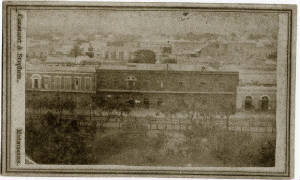
| Matamoras, Texas |
Abraham Lincoln proclaimed a blockade
of Confederate ports in April 1861; however, Texas had Mexico. Much of the Confederate cotton was traded through Texas and
Mexican ports such as Brownsville, Matamoros and Bagdad. By the summer of 1861 3,000 bales of cotton arrived in Matamoros
opening up a successful trade route for at least the first two years of the war until the Federals took Brownsville. Colonel
John “Rip” Ford wrote that Matamoros was soon filled with goods.
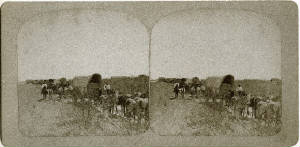
On her way to Mexico during the war, Eliza Moore McHatton-Ripley remembered seeing
in San Antonio “hundreds of huge Chihuahua wagons…parked with military precision outside” the city “waiting
their turn to enter the grand plaza, deliver their packages of goods and load with cotton.”1 By the end of the war 320,000 bales of cotton were sent to Mexico.2
With Brownsville in control of the Federal army, trade was diverted
to Eagle Pass further up the Texas gulf coast, a more difficult and costly route. This new trade route resulted in increased
prices and shortages for some goods. However, most shortages in Texas caused more of a general inconvenience rather than a
true life and death issue. Thread and cloth were dyed with home made natural dyes of bark, moss, pomegranates, berries, and
swamp willow. Almost always, the comments were “they are not very pretty”. The shortage of paper resulted in newspapers
cutting or ceasing publication. Letters were often short and written with homemade ink or in pencil. The ink too was made
with natural growth such as dogwood or oak, pomegranate rinds, elderberries, or green persimmons.
|
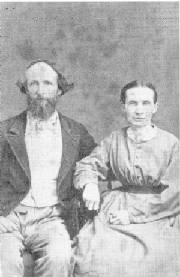
| William and Elizabeth Neblett 1875 |
Fruits and vegetables were readily available in the interior of
Texas throughout the Civil War as was beef and pork; few citizens in the inland were faced with starvation. Elizabeth Scott
Neblett was left to run the family farm and provide for her household when her husband joined the Confederate army. A Mississippi
native, Neblett’s family moved to Texas in 1839. Lizzie, as she was known, married a lawyer, William Henry Neblett,
in 1852. William enlisted in the Confederate army in 1863 and served as a company clerk in Galveston. In 1863 Elizabeth wrote
“I am now dining finely almost eat myself sick on beans, peas and Irish potatoes.”3 and “We have 14
middlings of meat now, but some are small, but I think they
would last us fully three months."4 Other Texans relied on wild game.
Slaves, on the other hand, relied on what their masters would
feed them. Reports of shortages from slave narratives range from Mary Lindsay in Fannin County reporting of nearly starving
to death to James Hayes stating “…things were about the same, like always, except some victuals were scarce.
But we had plenty to eat…”5
In 1862 Theophilus Perry wrote to his cousin Thomas Person “Every thing is
in great abundance except Coffee.”6 The loss of coffee was a tremendous sacrifice indeed.
According to Lt. Col. Freemantle “The loss of coffee afflicts the Confederates even more than the loss of spirits…”7
This is confirmed by Mary Maverick who wrote her son in 1864 “I bought a sack
of coffee Friday--fine-flavoured Havana--wish I could send you some. …we think it would be a great hardship to do without
it.”8
Former slave Mollie Watson of Leon County gave this description
of coffee substitutes to the WPA “De coffee was made outen rye or corn meal or sweet potatoes that was dried and parched.
When day made it from sweet potatoes dey would slice 'em and put 'em in de sun to dry lak dey did fruit or corn. When
it was plum dry it was put in de oven and parched and den dey would grind it in a little hand mill. It made purty good coffee
but Ole Miss and Squire Garner had Lincoln coffee to drink. Dey called it Lincoln coffee because it was real coffee. Dey couldn't
afford to serve it on de table as it was too 'spensive.”9
Another hardship was the shortage of flour. The lack of flour
and the complaints of corn bread resonate throughout Texas war time diaries and letters. With the price of cotton rising,
agricultural land usually dedicated to the production of wheat was given over to cotton. Then there was the problem of having
the manpower to plant, harvest and mill the wheat. Transportation was also an issue with many of the wagons and draft animals
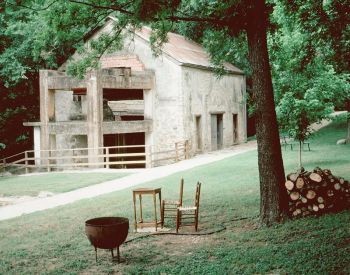
impressed for military. W.R. Hunt recalled “…that the only 'flour' we had was home-grown wheat, ground
on a grist mill, which turned out bran, seconds, shorts and flour all in the same sack. If we wanted to bake a cake for a
special occasion, we sifted this flour through home-spun cloth…”10
|
| Grist Mill. Landmark Inn, Castroville, Texas |
Corn bread was still better than nothing. After leaving Galveston
and refugeeing to Lavaca, Ann Raney Coleman experienced a shortage of corn meal. She describes the actions taken by the women
of the town:
One
day we got out of meal, and many families were suffering for bread, so the first time we heard of them grinding meal for citizens,
a good many ladies got together and went to ask for meal, but were refused, being told it was for citizens and not for us,
and that we could not have any. A few ladies took charge of the man who refused us, and the rest went and filled up all the
sacks, but not until we had threatened to set fire to the mill if we did not get it.11
Raney also describes
women mustering “en masse” and threatening the military personnel with pistols when rations were refused.
Not all food shortages could be blamed entirely on the war although
it did make it worse; a prolonged drought that resulted in a poor harvest in 1863 was followed by an unusually cold and hard
winter that brought freezing weather as far south as Brownsville decreasing yields or totally destroying crops. This crop
failure affected the citizens of Texas as well as the Texas troops who depended on the Texas crops. As soon as the drought
ended and after the hard winter crops were again abundant in Texas. In 1864 Maria von Blücher wrote “…superabundant
crops in Texas, and there are now shortages only in stray places where there are no farms in the immediate vicinity. …
at the moment there is an immense want of bread and fruit here at Corpus Christi.”12 Amelia Barr wrote “We
could never want food in Texas….”13
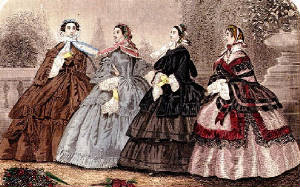
Clothing too, would eventually become an issue. But still as late as 1863 “A Practical Preacher” wrote to
the Austin State Gazette “Just visit our churches and public gatherings, where you will find no diminution
of finery, to laying aside of foreign manufactures and showing by their outward appearance what women can do by their independence,
industry, and self-denial, to sustain a righteous cause.”14
As the blockade continued
and fabric became scarce, just about everyone, regardless of wealth and standing began home production of some kind. Elizabeth
Neblett turned to tanning her own hides for shoes and recycling fabric such as reported in 1864 to her husband “I
have made up that green damask curtain dress…”15 Eventually she realized
she would have to also start weaving and spinning even as her husband protested “I do not like the idea of your weaving--it
is mortifying to me. I wish you would stop it.”16
Spinning and weaving was not a common occupation in Texas at the
outbreak of the Civil War. Looms and wheels were not readily on hand and had to be manufactured; a difficult task when the
men were in the army. Many women had to learn or re-learn the skill. Mary Maverick wrote to her son “…I took
lessons in spinning and showed quite a genius for carding and spinning. When my wheel comes I'll do something myself.”17
Women who had the ability
and the equipment set to making fabric for themselves and for the military. Gideon Lincecum wrote in 1863 “there are
no men in this vicinity, and the women won't do anything worth talking about. True, they are all busy spinning and weaving
and knitting and so forth, but that's becoming so common that everybody knows all about it; so I shan't say anything
on that topic.”18
Slave owning women often
had slaves who could spin and weave and who had been doing so prior to the war to clothe the slave population of the household.
Harriet Perry’s mother-in-law appears to have had a system already in place before the war. In 1862, Harriet wrote to
her husband, “Your Mother is making 90 yards of cloth a week---two looms going all the time.”19 Then on December 6, 1863, Harriet writes her mother-in-law had engaged to weave
120 yards for the government by Christmas. By February 1863 she, or at least the weavers in her household, are weaving 15
yards of cloth a day. It is mentioned in other
letters that the weaving and spinning is actually being done by a few of the female slaves rather than the white women of
the household
As much as Theophilus
Perry’s mother had spun and wove, his wife did not want to see her husband in homespun. She wrote in 1864: “You
spoke of a suit Lt Dukes had & expressed a wish for some like it and said you thought it better taste to wear home made
goods--It is cheaper for you to wear any other kind and I know it looks better than the homespun--the latter is so smutty
and dirty I do not like [it].”20
|
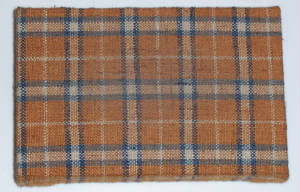
| Homespun. Pennsylvania State Museum, Harrisburg PA |
For many wearing homespun
was the last resort. Dresses were remade, turned, patched and dyed. Eventually calico became fashionable albeit expensive.
Lizzie Neblett even purchased a calico dress she had given to a slave. Kate Stone wrote in 1864 “We are at last using
homespun.”21
Another shortage that was felt particularly hard was men…or
at least their labor. Many of the shortages felt in Texas can be linked to the lack of man power to plant, harvest, mill,
and build. Maria von Blücher wrote in December 1862 “The natural consequences of all the men being soldiers is
that no field is tilled, and soon neither flour nor corn will be for sale, and anyone who cannot live on meat must starve.”22
Some crops were left in the field to rot
due to the lack of man power to harvest them, adding to the shortages already induced by the drought and frost. Women petitioned
to have men excused from military service so that they may remain in the communities to build looms and spinning wheels, run
the mills and help run the farms.
Still, women in Texas, as in other
southern states, found themselves doing men’s work. A number of Texas women were quite resourceful and dealt with their
circumstances well. They found they were capable of managing large farms, planting and harvesting crops, slaughtering livestock,
managing slave populations, and the business of selling and trading crops and other farm goods. At the same time they continued
their regular duties of caring for children and kitchen gardens, sewing and cooking. Granted, many of the accounts surrounding
these tasks were left by women who had slave help. Dealing with the management of their farms, at times, was more than some
women could stand, even with slave labor, as stated by Elizabeth Neblett “I am so sick of trying to do a man's business…"23
|


