|
Even with the Native American uprisings, raids out of Mexico and
Federals in the Gulf, Texas was seen as a safer place than most of the other southern and border states. Refugees from Missouri,
Louisiana, Tennessee, Mississippi, Kentucky and Arkansas pushed into Texas throughout the war moving their property, slaves
and families. As early as December 1860, Gideon Lincecum wrote in a letter “Immigrants are crowding in upon us….They
have run off with their negroes, most of them from the border states to get them out of the way of the hell-bent fanatics.”1
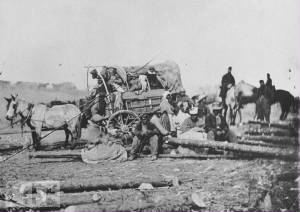
Former slave Harriett Robinson of Bastrop County remembered “Master
made all us niggers come together and git ready to leave' cause the Yankees was coming. We took a steamer….Then
we got on a steamship and pulled out to Galveston….We was on the bay, not the ocean. We left Galveston and went on
trains for Houston.”2
The Texas newspapers frequently commented on the number of vehicles
and people on the roads to Texas. In November 1861, the Austin State Gazette reprinted a piece from the Waco
South West describing the refugees from Missouri:
Scarcely a day passes that we do not see from one to a dozen
wagons in our town, accompanied by men, women and children--white and black--fleeing from oppression in Missouri….Many
of them, as soon as they can get homes for their families, intend returning to assist in expelling the Vandal hordes who are
now desolating their once peaceful and happy homes.3
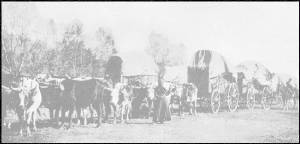
The Galveston Weekly News reported in December of 1862
“The roads leading from Louisiana to Eastern Texas are said to be still filled with wagons coming into Texas.
These wagons belong to refugees from Louisiana, who are bringing with them their families and negroes and all the effects
they have left. As many as 50 or 60 wagons are often seen in a train.”4
Some of the most descriptive accounts of the road to Texas during
the war come from the remembrances of former slaves. Mary Lindsay was interviewed by the WPA in Tulsa Oklahoma in 1937. Mary
was the slave of William and Mary Merrick of Fannin County in north Texas. “By and by the people got so thick on the
big road that they was somebody in sight all the time. They jest keep a dust kicked up all day and all night 'cepting
when it rain, and they git all bogged down and be strung all up and down the road camping….They was whole families
of them with they children and they slaves along, and they was coming in from every place because the Yankees was gitting
in their part of the country, they say.”5
Allen V Manning, another former slave was interviewed the same
year as Mary Lindsay by the WPA, also in Tulsa. Manning was a slave in Coryell County, just west of Waco. He remembered: “The
next spring old Master loaded up again and we struck out for Texas, when the Yahkees [sic] got too close again….About
that time it look like everybody in the world was going to Texas. When we would be going down the road we would have to walk
along the side all the time to let the wagons go past, all loaded with folks going to Texas.”6
Many of the refugees found themselves in east Texas renting houses
or merely rooms from the resident population. But they were not always welcome; in fact so unwelcomed that the governor of
Louisiana felt it necessary to reprimand Texas on the treatment of Louisiana refugees saying “Many [refugees] have brought
or sent back painful accounts of their reception. There should not be wanting the exercise of another knightly
quality—the duty of hospitality.”7
Indeed, Kate Stone, who had refugeed to eastern Texas with her family from Louisiana
in 1863 records refugees being called renegades, Texans refusing to visit the newcomers, and refugees experiencing prejudice
such as not being welcome at public gatherings.
Added to the out-of-state refugees, the Texas interior also hosted
refugees from the Gulf Coast after the Federal invasion of 1862. Coastal residents fled their homes to find lodging in Houston
and points further inland. Some Texas refugees found themselves with nowhere to go as reported by the Austin State Gazette
in January 1863 “Hundreds of people are now on the prairie without anything to eat, or shelter of any kind.”8
|


